
The Disposable Revolution: Why Restaurants Are Ditching Plastic Plates for Compostable Alternatives
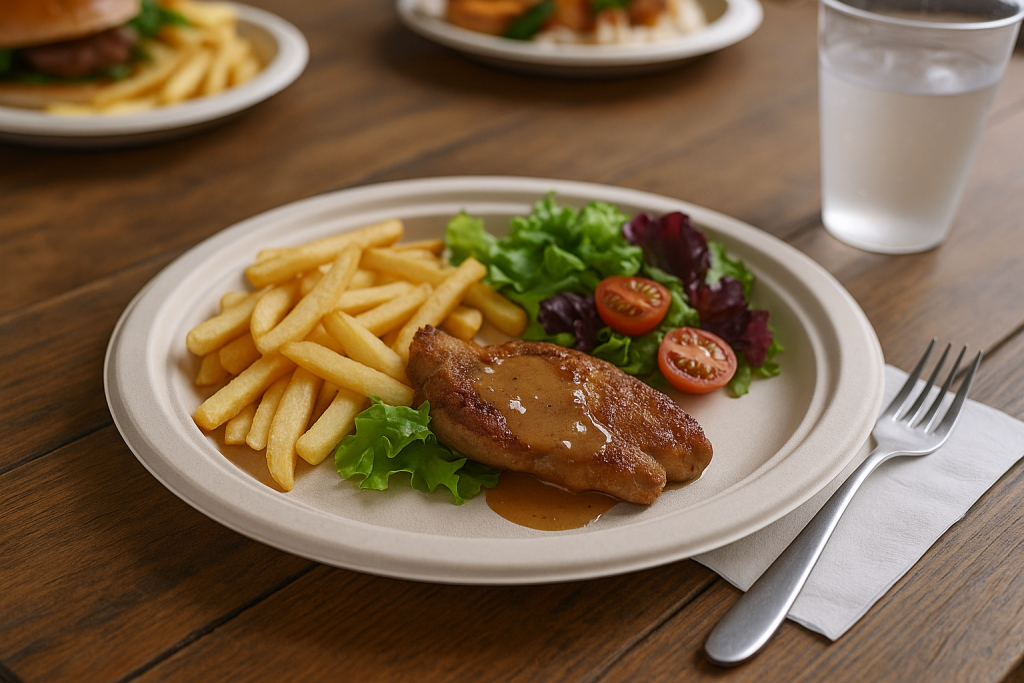
Inside the growing trend that’s transforming fast food, takeout, and casual dining — and how Bioleader® is leading the charge with high-performance biodegradable plates
The Restaurant Reality: Plastic Is Losing Its Seat at the Table
It’s lunch rush hour at a busy burger joint. The smell of fries fills the air. Trays of burgers, drinks, and desserts stream out of the kitchen—each meal plated on a plastic or foam dish that will live for 400 years.
The customers finish eating in 15 minutes. The plates? They’ll still be around when the restaurant itself is long gone.
This everyday scene has quietly become one of the food industry’s biggest sustainability dilemmas. According to the United Nations Environment Programme, single-use plastics contribute to 11 million tons of waste entering the oceans each year, with disposable food packaging among the worst offenders.
That statistic alone explains why restaurants worldwide are now looking for sustainable alternatives like bagasse plates — durable, grease-resistant, and fully compostable dishes made from sugarcane fiber.
The Science Behind Bagasse: Turning Waste into Wonder
Bagasse is the fibrous residue left after sugarcane juice extraction. Instead of burning it or sending it to landfills, manufacturers like Bioleader® have transformed this agricultural byproduct into strong, lightweight tableware that can withstand both heat and moisture.
In lab tests, bagasse decomposes completely within 60–90 days in composting conditions — far outperforming conventional paper or plastic. Even more impressive, each ton of bagasse used in production prevents around 1.5 tons of CO₂ emissions, since it replaces petroleum-based materials.
That’s why foodservice brands, from street vendors to large QSR chains, are switching to products like Bioleader’s disposable biodegradable plates — designed to deliver both performance and peace of mind.
These plates hold up under hot curry, cheesy pasta, or oily burgers without sagging or leaking. They look simple, but they represent years of R&D in material engineering, heat pressing, and natural fiber bonding.
The Business Case: Why Restaurants Are Making the Switch
Many restaurateurs hesitate to switch from plastic due to cost concerns. But when examined closely, compostable tableware often provides total cost parity or even savings when considering waste disposal fees, brand reputation, and compliance with new regulations.
Consider this:
- The EU’s Single-Use Plastics Directive and similar bans in 70+ countries are already penalizing plastic packaging.
- Compostable packaging often qualifies for tax incentives and helps avoid eco-compliance fines.
- Customers notice — surveys show 73% of diners prefer eco-friendly brands and 58% are willing to pay 5–10% more for sustainable dining.
In short, sustainability isn’t just ethics anymore — it’s economics.
That’s where Bioleader® comes in. The company’s disposable paper plates offer a practical balance between price and performance, manufactured at scale to support both local cafés and international food chains.
Case Study: The Chain That Saved $40,000 in Waste Fees
A Pakistani fast-casual restaurant group, serving 10,000 meals a day across 25 outlets, faced a challenge: its foam plates were banned under new municipal environmental rules.
Switching suppliers wasn’t easy — early compostable trials resulted in leakage and product failure.
Enter Bioleader®. The company customized bagasse-based plate designs with thicker rims and double-pressed centers, optimized for local dishes like biryani, chicken karahi, and cheesy loaded fries.
After the rollout, the chain achieved:
- 82% reduction in waste disposal volume
- 35% customer improvement in brand perception (“eco-friendly restaurant” mentioned in feedback forms)
- $40,000+ in annual waste management savings
The CEO later commented:
“Bioleader’s biodegradable plates didn’t just solve a compliance issue — they helped us relaunch our brand as clean, modern, and responsible.”
The Material Comparison: Plastic vs. Bagasse vs. Paper
| Property | Plastic Plate | Paper Plate | Bagasse Plate (Bioleader) |
| Decomposition | 400+ years | Not compostable (PE coated) | 60–90 days |
| Heat Resistance | Up to 70°C | Warps easily | Up to 120°C |
| Oil & Water Resistance | High | Medium | Excellent |
| Compostability | None | Partial | 100% |
| Carbon Emission | High | Moderate | 70% lower |
| Food Safety Certifications | FDA only | Varies | FDA, LFGB, EN13432 |
These statistics show why environmentally friendly paper plates are quickly replacing traditional disposables. They merge the convenience of single-use dining with the integrity of circular production.
How Bioleader® Builds Better Plates
Bioleader’s production facility in Xiamen, China spans over 20,000 square meters — a fully automated, ISO 9001 and BRC-certified operation capable of producing hundreds of millions of units annually.
But what truly distinguishes the brand is its scientific process:
- Raw Material Selection – Only food-grade sugarcane fibers sourced from verified mills.
- Pulp Refinement – Impurity removal, sterilization, and pH balancing.
- High-Pressure Molding – Uniform thickness with zero deformation.
- Heat Sterilization – Each batch UV-treated and micro-tested for hygiene.
This meticulous engineering allows Bioleader’s biodegradable plates to outperform most market alternatives in tensile strength, grease resistance, and compostability speed.
As a result, distributors in more than 60 countries — from the Middle East to North America — trust Bioleader for private label and bulk OEM production.
Data-Driven Insights: The Real Impact of Switching
According to lifecycle assessment models from the University of Michigan, replacing 10,000 plastic plates with bagasse equivalents can save:
- 62 kg of CO₂ emissions
- 24 liters of crude oil
- 33 kg of landfill waste
And when used across a single fast-food chain operating 50 outlets, these savings scale into thousands of metric tons of avoided emissions annually.
It’s small changes — like switching to compostable plates — that make massive cumulative impact.
The Consumer Shift: How Dining Culture Is Evolving
The post-pandemic world has accelerated “conscious dining.” Takeout packaging, once an afterthought, is now a visible symbol of a brand’s ethics.
In a 2025 global survey by Deloitte, 67% of restaurant customers said they judge a brand’s eco values based on its packaging materials.
That’s why brands like Starbucks, McDonald’s Japan, and countless local eateries are piloting bagasse or plant-fiber packaging programs. The trend is no longer limited to luxury restaurants — it’s mainstream.
For foodies, compostable plates have become part of the dining experience — lighter, cleaner, and guilt-free.
Why Bioleader® Is Setting the Benchmark
While many suppliers claim “green,” few back it with certifications, factory transparency, and consistent quality. Bioleader’s strength lies in three key pillars:
- R&D Leadership: Developing high-performance bagasse and pulp-based composites.
- Scale Manufacturing: Delivering container-load supply with tight quality control.
- Global Compliance: Meeting EN13432, ASTM D6400, and OK Compost certification standards.
Its eco product lines now include plates, bowls, trays, and clamshell boxes — all made from renewable materials like sugarcane bagasse and kraft paper.
Global clients praise Bioleader for its fast lead times, multi-SKU loading flexibility, and excellent communication — rare in the export packaging world.
As one long-term partner in Europe said:
“Bioleader isn’t just a supplier; it’s a sustainability collaborator.”
The Road Ahead: Sustainable Dining as Standard Practice
As governments tighten environmental regulations and consumers demand accountability, disposable plastic’s days are numbered. Bagasse and compostable tableware will soon become the default for restaurants worldwide.
Analysts project the global molded pulp tableware market will reach $12 billion by 2030, driven by urbanization, ESG reporting, and zero-waste commitments.
Bioleader® is already prepared for that future — blending technology, transparency, and environmental purpose to redefine disposable dining.
Conclusion: The Future Is Served on a Bagasse Plate
A restaurant’s success today isn’t measured only by taste — it’s measured by impact. From carbon footprint to customer perception, every decision matters.
Bioleader® offers restaurateurs a way to serve responsibly without sacrificing quality. Its compostable and biodegradable plates represent not just a product, but a philosophy: convenience that cares.
In the end, the best meals aren’t just delicious—they’re sustainable.